Each week I reverse engineer the products of leading tech companies. Get one annotated teardown every Friday.
Growth Dives: Inside Linear’s onboarding: 3 things I didn’t expect
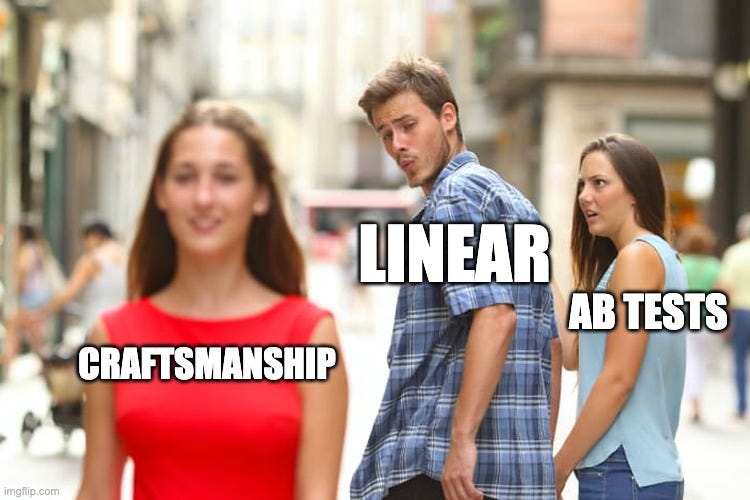
The onboarding Linear built without any AB testingGetting to $1.25 billion without data or hacks Download a PDF of this article here What’s the secret behind a tool used by OpenAI, Ramp and over other 15,000 companies? Apparently not running any AB tests. 🫨🫨🫨 Enter: Linear. Linear is a project and issue tracking tool for product and engineering teams. It’s like if Notion and Jira had a baby: it’s minimal and design-first (like Notion) but does the heavier product and engineering workflows people use Jira for. In June earlier this year, Linear announced a $82M Series C at a $1.25B valuation. Which, if the valuation is at a 20x multiple of annual recurring revenue, puts their revenue at around $62.5 million a year. In their fundraise announcement, Co-Founder and CEO Karri Saarine wrote a piece about their product culture and journey so far called Six years, our way. He shared: We’ve built Linear without running a single A/B test and without chasing metrics or looking to data for answers. This feels crazy to me; that they’ve gone 6 years without running an AB test. They also have no metrics-based goals, just one North Star as a company-level metric goal. Karri goes on to explain: “I believe that building companies is a kind of craft. You’re creating something one of a kind. It’s shaped by a very specific group of people, in a very specific moment in time. You can never really replicate that or manufacture it again. And for most founders, it will be the only company you’ll ever build. That makes how you build just as important as what you build. Therefore, the way you craft should be important to you, and not just a means to an end.”
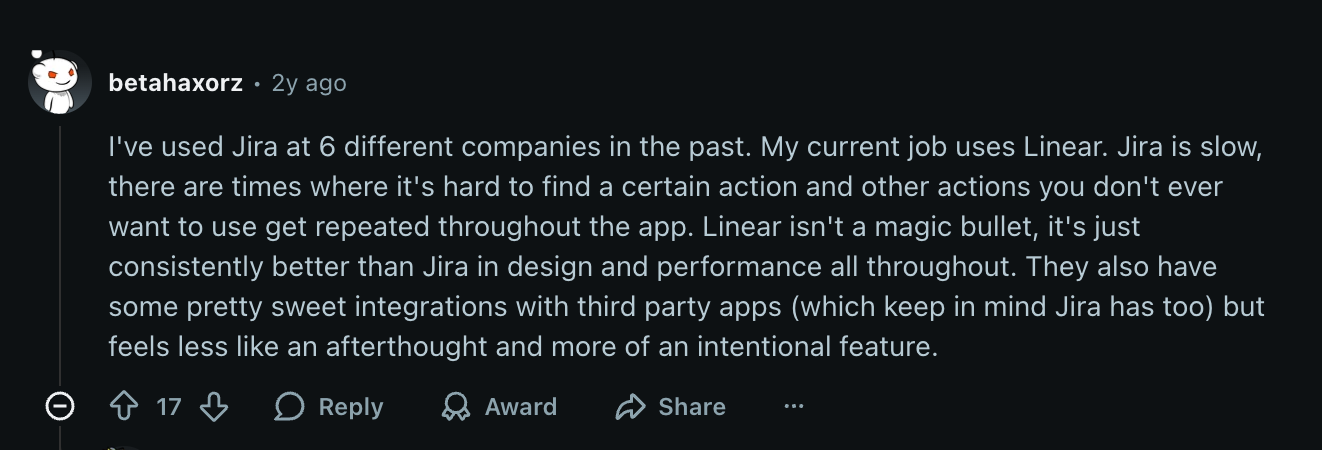
What I find most interesting is how Linear has been able to take over from Jira for certain customer segments. Linear is preferred by fast-growing startups for how light and simple it is, while classically Jira is seen to be better in larger, enterprise organizations (though this might be changing). Switching to a new workflow tool is painful (as work tools are so embedded they often become part of peoples’ CVs). Which is exactly why these customers moving is worth paying attention to. According to one review on reddit, Linear is “not a magic bullet” instead “it’s just consistently better in design and performance”.
All of that made me curious to see whether the product actually feels as good as people say. With this mystique of product craftsmanship, strong growth and good reviews on reddit, I was keen to give it a try. So, when I joined the Fyxer workspace on Linear of course I screenshotted the whole journey.
And the best place to see whether that craft shows up is the onboarding: the first impression. Three things jumped out immediately from the onboarding flow:
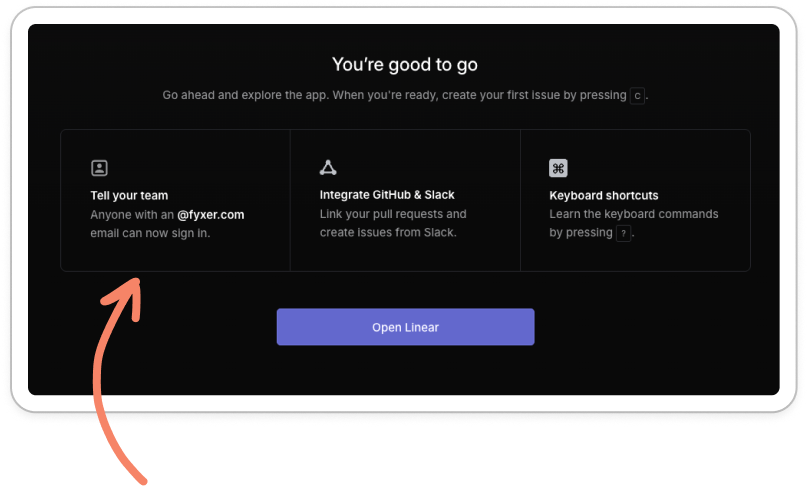
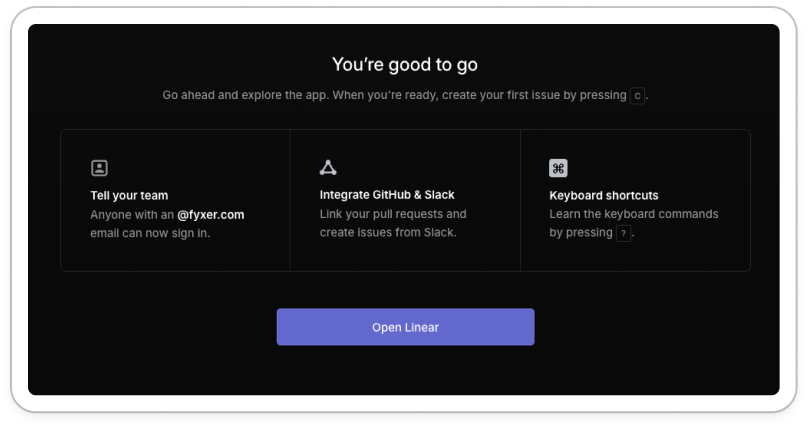
As well as these four learnings, there was three curious things I wasn't expecting. So let’s start with the first thing that surprised me: the lack of invite triggers. First surprise: I never got an invite to Linear.As I was pasting screenshots for this deep dive into Figma, I was searching and searching through my gmail to find the invite email for Linear. I checked my deleted folder. Nothing. I couldn’t find it. So, I thought: ‘I must have deleted it and cleared my bin, oh well’. Until, I noticed this screen at the end of onboarding:
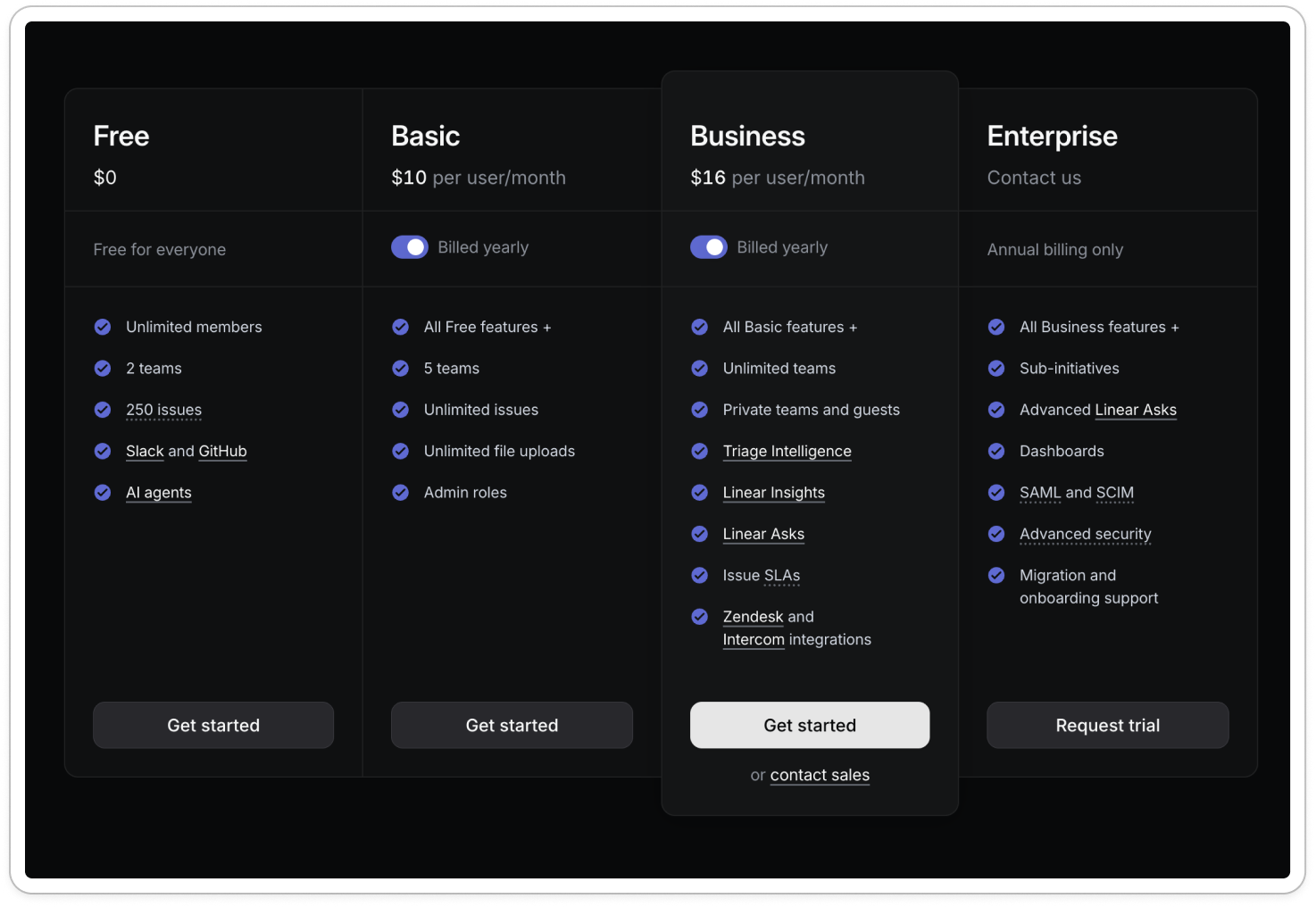
Tell your team Anyone with an @fyxer.com email can now sign in. What this means is that anyone in our business can join without an invite. Expansion within the team is therefore frictionless and relies on word-of-mouth rather than invite triggers. As teams share links to tickets and builds, the rest of the team will naturally join. With this flow, there’s no: ‘Can someone add me to the team’ ‘Who has invite permissions?’ ‘I still don’t have access, can someone help?’ Once teammates join, Linear will bill based on team signups from the same domain. $10 per user per month for basic, or $16 per user per month for Business.
For this to work, people need to use the product, so that Linear links start appearing in the wild across Slack and in messages. These projects and conversations will naturally pull team members into Linear (and increase the bill). That expansion and adoption cycle relies on one thing: how quickly someone gets value. Second surprise: the onboarding was…unconventionalMost onboarding start with account set-up:
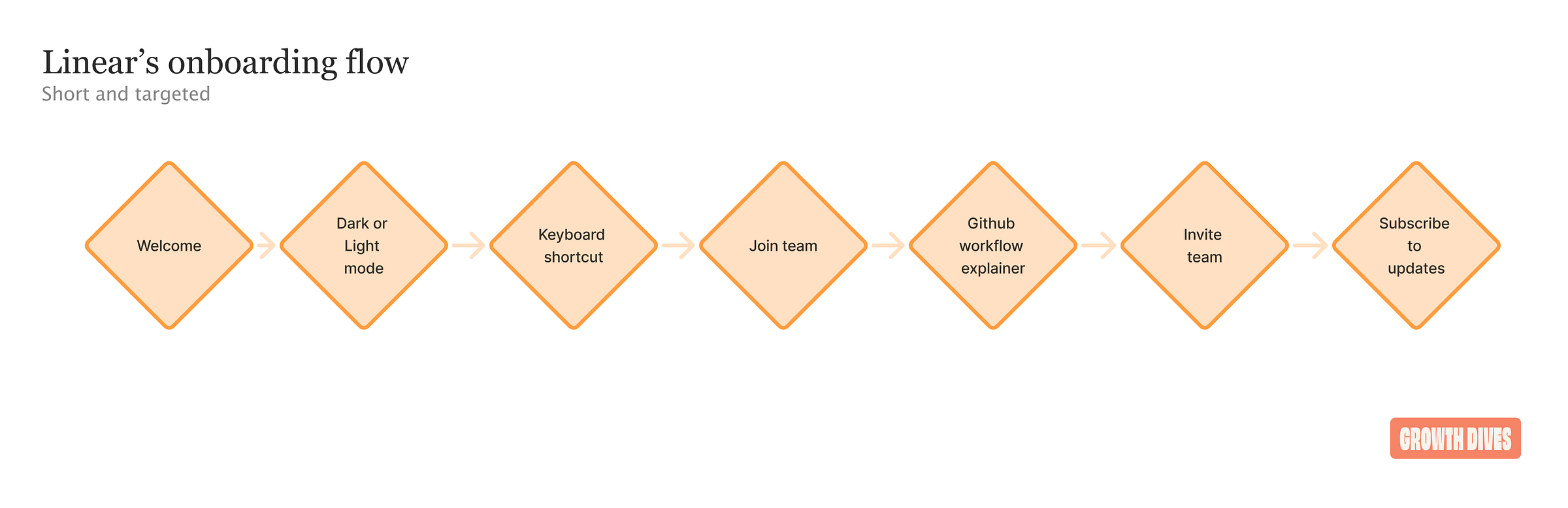
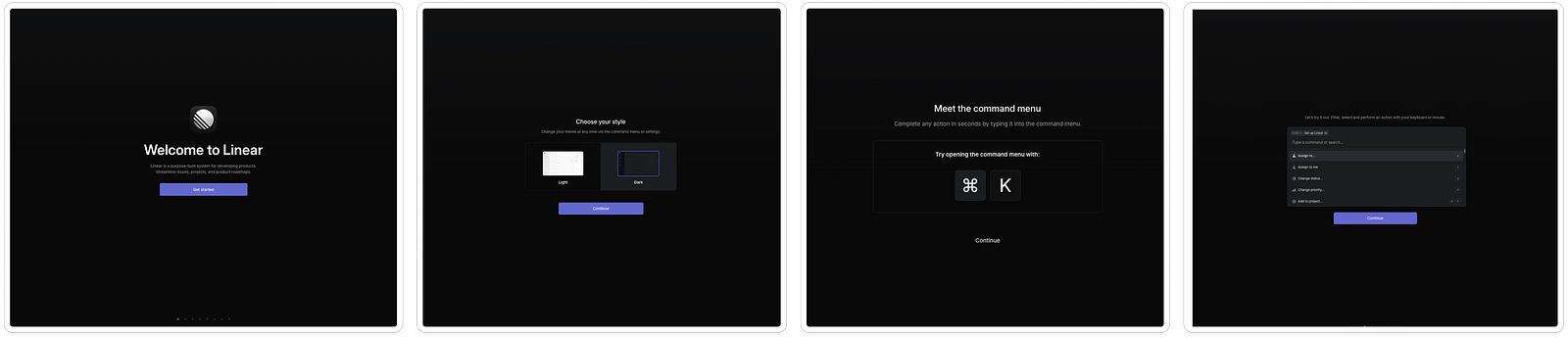
Not Linear. There’s six main actions in onboarding after signup:
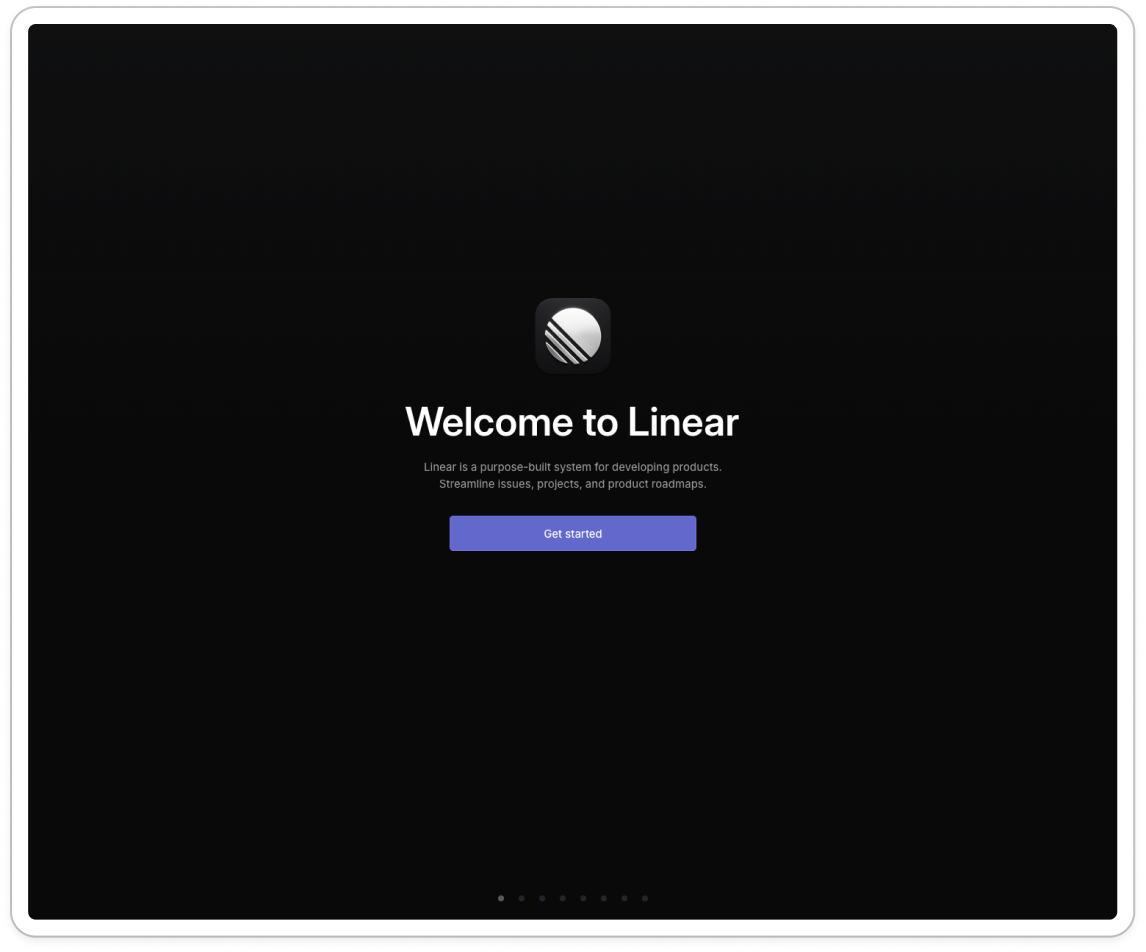
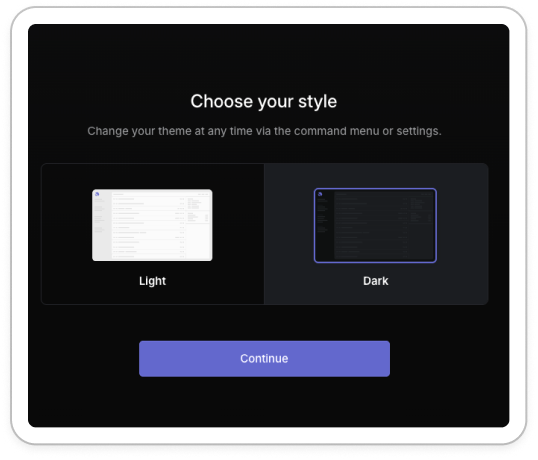
After the welcome screen I was asked about light or dark mode immediately.
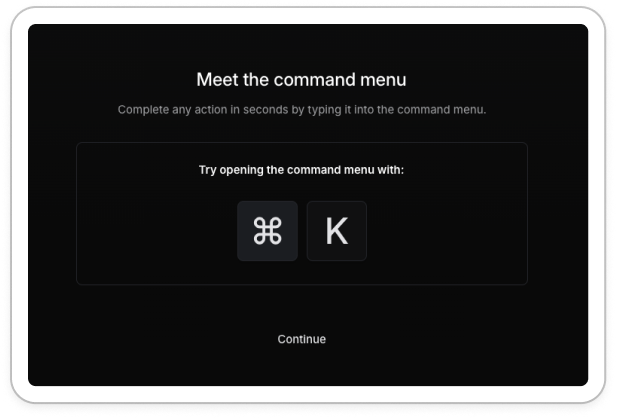
Then, I was asked to use a keyboard shortcut to open the command menu.
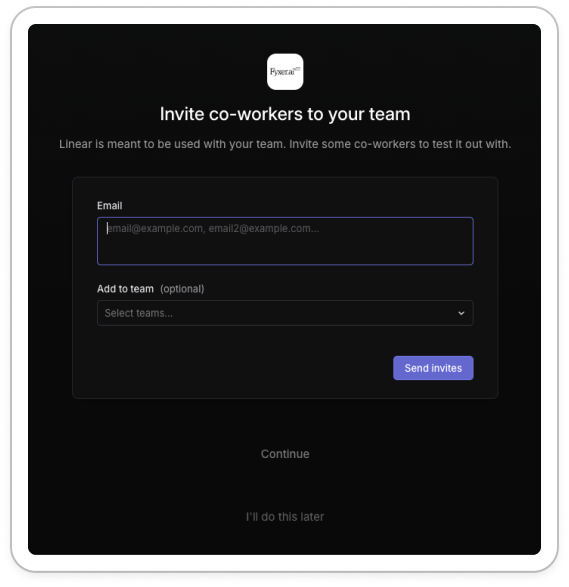
Only then was I asked to join my team, invite more people and check out the GitHub integration. But giving me some choices early on, Linear is subtly showing me:
The theme choice changes the mood of the whole flow. And most engineers live in dark mode, so letting them switch immediately makes everything feel calmer.
Zooming out, this approach fits their “craft over data” philosophy. A data driven team might not have put dark/light mode first, because (I suspect):
But a craft-led team might put it first because:
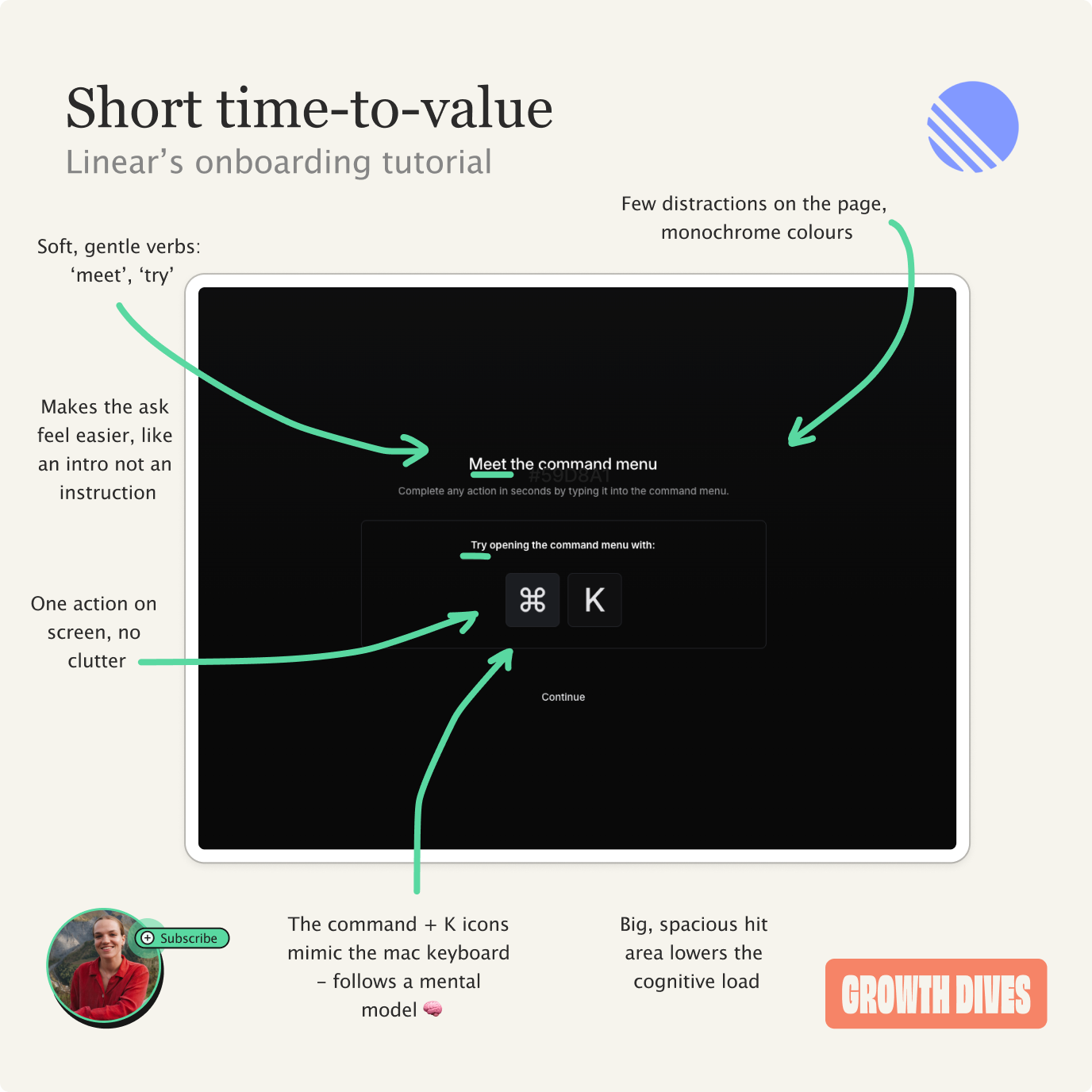
In the midst of this onboarding flow, I completed a tiiiiny tutorial: keyboard shortcuts. Specifically the shortcut to bring up the command menu: ⌘ + K The visual was so clear: large buttons that look like my mac keyboard, soft language.
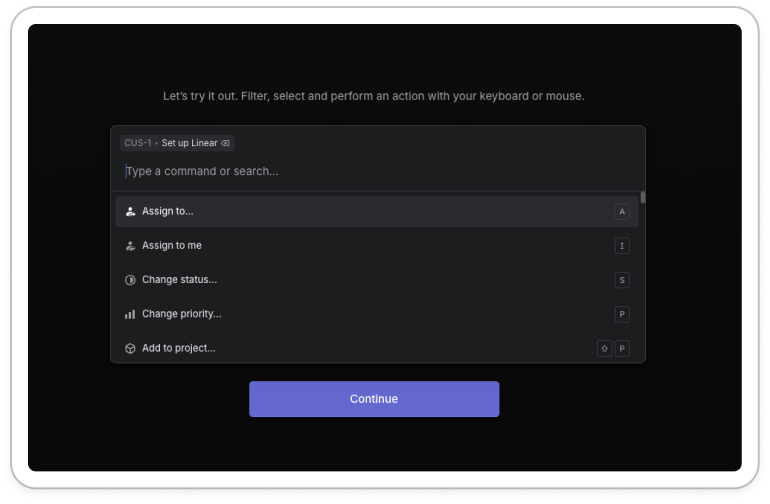
It’s the friendliest way to teach a shortcut: one thing to do, calm visuals and big keyboard-style buttons that make it feel like muscle memory. What popped up next wasn’t as simple, but the language was still soft:
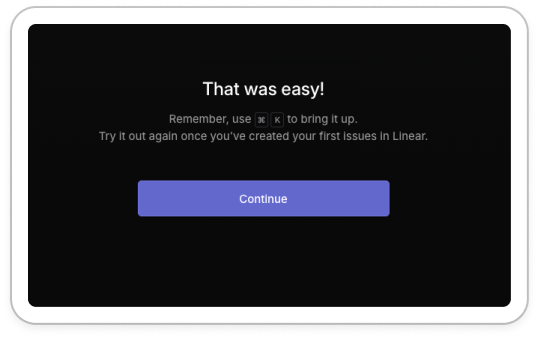
After my foray into shortcuts, I was congratulated:
But also reminded of the shortcut, to make it into a habit. And told what the next most important action is. Next, I’m asked what team I want to join, with the colleague counts and avatars nearby (a nice little bit of social proof and bandwagon effect 🧠).
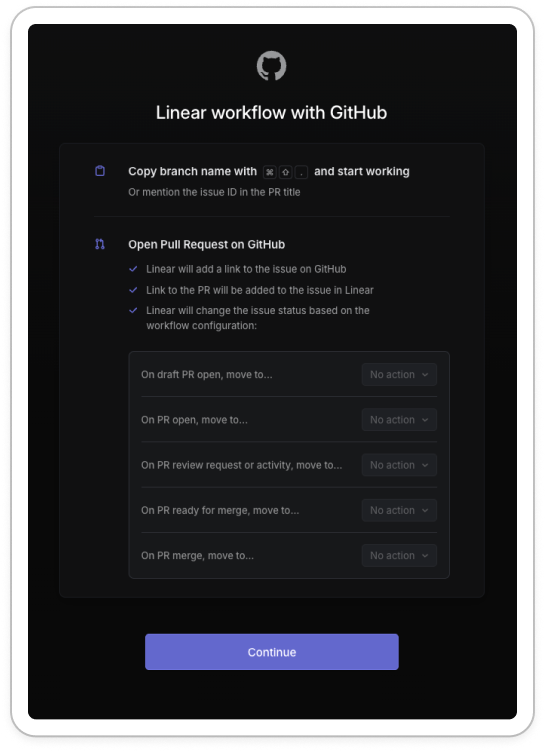
Something to note here: the UX is so clean and delineated between joining an organization vs. creating a new organization. How many of us have accidentally created a duplicate company when signing up to something? 🙋🏻♀️ 🙋🏻♀️ 🙋🏻♀️ oopsie. This Linear screen makes that mistake easy to avoid. After joining the Fyxer team, I'm onto the GitHub integration page:
Here Linear is saying:
As a user, I see: less manual work, more syncing. Yay. After all of this, something else started to stand out to me across these screens. Linear wasn’t showing me much visually at all. It was… talking to me instead. Third surprise: words are preferred over imageryMost of the time, I’d say “use imagery to subtly communicate how things work to customers”, or “show customers value as soon as possible in imagery”. Not in Linear’s onboarding flow. Instead of showing you the product, they lean entirely on calm, simple copy to guide you through each step. On the invite screen, the copy is: Linear is meant to be used with your team. Invite some co-workers to test it out with them.
On the ‘subscribe to updates’, the copy again leans toward the simple: Linear is constantly evolving. Subscribe to learn about changes.
And, on the last screen of onboarding, again it’s so simple: You’re good to go Go ahead and explore the app When you’re ready, create your first issue by pressing c
There’s no confetti. No celebration. No ‘yay you’re in!’. Just calm energy. Each screen speaks in short, steady sentences that feel minimalist (just like the design) and confident. The minimal flow feels like it trusts that you’ll understand when you get inside. Part of me makes it feels like the onboarding is the start of a mystery movie, where you’re itching for it to get to the real story. There are other benefits to this simplicity of the language:
Again, craft over design. My one pet peeve is how small things are on the screen 🤏 (I had to do a lot of zooming in and squinting). In conclusion: a quiet, calm onboardingStepping back, how do I feel at the end of this flow? I feel calm. And, in the moment I didn’t actually notice it much, which is probably the point. The flow doesn’t push, celebrate or demand much from you. Linear’s onboarding isn’t trying to be impressive or clever. It doesn’t rely on animations, product tours or growth tricks, but instead it shows you that it’s a tool designed for you (as an engineer or product person). Because of that, it still manages to reduce friction, speed up time-to-value and make team adoption feel natural. You move through the flow without ever feeling lost or overloaded, and before you know it, you’re in the product. Yipee. For an onboarding with no AB testing, it’s impressive. It shows what can happen when you design the whole thing end to end with a clear understanding of the user, rather than optimizing each screen in isolation, or jamming people through steps to hit metrics. Will I never run an AB test again? No. But will I think a little differently now? Quite possibly yes. What this really shows is that there are many ways to build things and many ways to execute well. Thank you SO much for reading (all the way to the bottom, wow look at you go). See you next week, Rosie 🕺 |


Growth Dives
Each week I reverse engineer the products of leading tech companies. Get one annotated teardown every Friday.